
Davis-Bacon wage rates for 2026: how to find and read yours
By Matt Kerr, who makes Count Twice in Grand Rapids · Checked 9 November 2026
There's no single 2026 Davis-Bacon rate. The Department of Labor sets rates by county and by type of construction, in documents called wage determinations, and each trade gets a base rate and a fringe. They're free on SAM.gov. The one you owe is the one written into your contract, with its modification number.
- Kent County, Michigan, where I'm based, has 6 active federal wage determinations today, one or more for each type of construction.
- In its building determination, a millwright's line is $40.04 plus $26.47 fringe. A carpenter's is $18.14 plus $4.59.
- 30 of that determination's 45 trade lines come from a wage survey dated 2011.
Got your rates? Check your payroll against them. Count Twice is a free checker I built. Type each trade's rate and fringe, drop in one week of payroll as a CSV file, and it flags pay under the base rate, short fringe, overtime under time and a half, and apprentices over the ratio.
Free, with no account. Your file stays on your computer. Nothing is uploaded or saved.
Find yours on SAM.gov
- Look in your contract first. The bid documents or contract name the wage determination, like MI20260088, and its modification number. That's the one you pay from, even when SAM.gov shows a newer modification. The rules for which one counts are below.
- No number yet? Search SAM.gov. Open SAM.gov's wage determinations page and search Construction (DBA). Filter by state and county, pick the DBA construction type (building, residential, heavy or highway), and keep the status on Active. No sign-in is needed.
- Open the match and read its Document tab. That's the full text, with Print and Download buttons. The History tab lists every modification.
- Write the number and modification on your WH-347. The form has a box for every wage determination that covered work that week.
What Kent County shows today
I ran that search for Kent County, Michigan on 9 November 2026. Six active determinations cover it:
| Number | Type | Area | Mod, date |
|---|---|---|---|
| MI20260088 | Building | Kent County | 1, 18 May 2026 |
| MI20260025 | Residential | Barry, Ionia, Kent and Newaygo | 1, 18 May 2026 |
| MI20260062 | Heavy | Kent County | 1, 18 May 2026 |
| MI20260157 | Heavy | Most counties, Kent included | 1, 18 May 2026 |
| MI20260158 | Heavy | Most counties, Kent included | 1, 18 May 2026 |
| MI20260001 | Highway | Most counties, Kent included | 3, 25 June 2026 |
Heavy work has three, so the one in your contract is the one that counts. If the contract doesn't name one, ask the contracting officer before you bid.
How to read a rate line
Here are five lines from Kent County's building determination, MI20260088, modification 1:
| Identifier | Trade | Rate | Fringe |
|---|---|---|---|
| PLUM0174-002 07/01/2025 | Plumber, excludes HVAC pipe and unit installation | 47.40 | 23.35 |
| CARP1102-001 06/01/2025 | Millwright | 40.04 | 26.47 |
| SUMI2011-013 02/01/2011 | Electrician, excludes low voltage wiring | 20.68 | 6.39 |
| SUMI2011-013 02/01/2011 | Carpenter, excludes acoustical ceiling installation, drywall finishing/taping, drywall hanging, and formwork | 18.14 | 4.59 |
| SUMI2011-013 02/01/2011 | Laborer: common or general | 13.04 | 4.80 |
The identifier says where the rate came from
Each determination explains its own codes at the end. In short:
- Four letters and a number, like PLUM0174: a union rate prevailed in the survey. PLUM is the plumbers' union and 0174 is the local. The date is when the current bargained rate took effect.
- SU, like SUMI2011: a survey rate, either a single non-union rate that prevailed or a weighted average of everything reported. MI is the state and 2011 is the survey year. The date is when the survey was completed.
- UAVG: a weighted average of union rates, updated once a year, usually in January.
- SA: rates a state or local government set, adopted by DOL.
The SU codes matter here. The determination says survey rates "typically remain in effect until a new survey is conducted." So in Kent County today, 30 building trade lines still carry 2011 survey rates, including the electrician, carpenter, roofer and bricklayer lines. DOL can raise non-union rates by its cost index, but no more often than every 3 years, under 29 CFR 1.6(c)(1). These are floors. You can always pay more.
Rate is the cash part, fringe can be either
The Rate column is the base hourly rate, and you pay it in cash. You can pay the Fringe column into bona fide plans, as extra cash, or as a mix (29 CFR 5.31). Take the carpenter line, $18.14 plus $4.59:
- $18.14 an hour in wages, plus at least $4.59 an hour into plans, or
- $22.73 an hour, all in cash, or
- any mix, as long as the cash wage is at least $18.14 and the total is at least $22.73.
Plan payments count by the hour over the whole year. Divide what the plan costs by every hour the worker works that year, on all jobs (29 CFR 5.25).
Overtime uses the rate, not the fringe
Overtime is at least 1.5 times the base rate, and the fringe is added at its straight amount (29 CFR 5.32). For that carpenter: $18.14 times 1.5 is $27.21, plus $4.59 fringe, so $31.80 for each overtime hour. Paying 1.5 times $22.73 is fine, but it's more than the least you owe.
Which modification you owe
General wage determinations have no end date. Each stays good until DOL revises, replaces or cancels it. Which revision binds your job comes down to dates, under 29 CFR 1.6:
- Once a wage determination is in the contract, it generally holds for the life of the contract.
- For sealed bids, a revision published at least 10 calendar days before bid opening applies. One published after bid opening doesn't.
- Published less than 10 days before bid opening, it still applies, unless the agency finds there wasn't time to tell bidders and puts that finding in the contract file.
- If the contract isn't awarded within 90 days after bid opening, revisions published before the award apply. The agency can ask DOL to extend that.
So check the modification number in your contract against the History tab on SAM.gov, and pay from the one your contract carries.
The notes under the rates
MI20260088 prints three notes after its rates.
- Executive Order 13658 minimum wage: $13.65 an hour from 11 May 2026 through 31 December 2026, or the determination's rate if it's higher. It generally covers Davis-Bacon contracts awarded from 1 January 2015 to 29 January 2022 and not renewed or extended since 30 January 2022. It doesn't cover contracts under only the related acts. On a covered contract, Kent County's $13.04 laborer rate and $10.47 landscape rate become $13.65.
- Executive Order 13706 paid sick leave: on contracts awarded on or after 1 January 2017, 1 hour of paid sick leave for every 30 hours worked, up to 56 hours a year.
- Trades that aren't listed: they can be added after award only through the contract's labor clauses, 29 CFR 5.5(a)(1)(iii). DOL's WH-347 instructions say to contact the contracting officer right away.
One rule you won't see: Executive Order 14026's higher contractor minimum wage. DOL's page on it says that after Executive Order 14236 of 14 March 2025, "the Department of Labor is no longer enforcing Executive Order 14026."
Questions about a determination go to DOL's Branch of Construction Wage Determinations at BCWD-Office@dol.gov, the address printed at the end of each one.
Michigan state jobs use state rates
A job paid with Michigan money, not federal, follows Michigan's own prevailing wage law and the state's own rates, which LEO updates every year on 1 November. Contracts that already carry federal Davis-Bacon rates are exempt from the Michigan law. How Michigan's rules and online filing work.
Then check your payroll against them
Once you have the rate and fringe for each trade on the job, type them into Count Twice with one week of payroll. It checks every worker's hours against them. Here's its result on the made-up sample week, which has four mistakes planted in it.
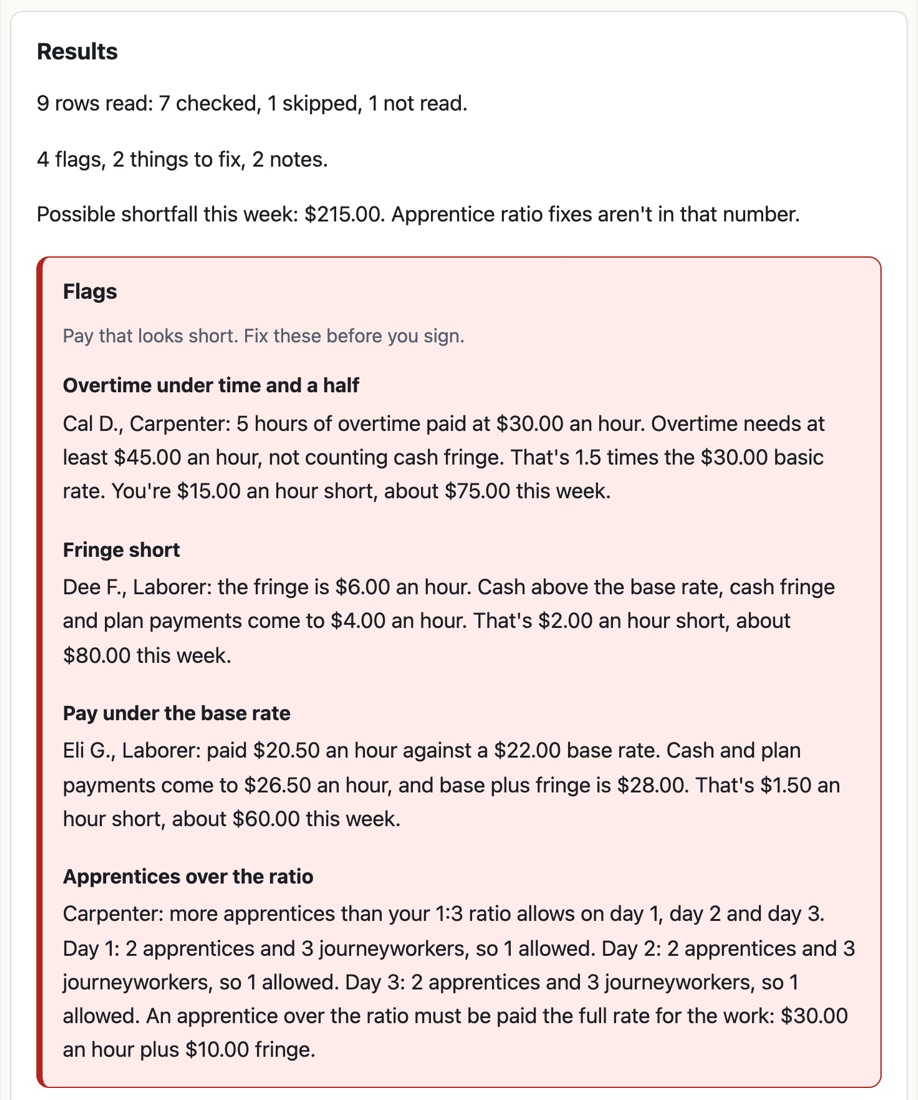
Count Twice checks math against the rates you type. It doesn't pick your wage determination or decide which trade a job belongs to, and it isn't a lawyer.
Next: putting the rates on the form
The rate goes in column 6A of the WH-347, plan fringe in 6B and cash fringe in 6C. How to fill out the WH-347, line by line covers every box, with a filled-in row.
Sources, read 9 November 2026: MI20260088, modification 1 and the Kent County search on SAM.gov; 29 CFR 1.6, 5.25, 5.31 and 5.32; DOL's pages on Executive Order 14026 and the Executive Order 13658 minimum wage; DOL's WH-347 instructions.