
New Jersey prevailing wage: the rates, registration and certified payroll
By Matt Kerr, who makes Count Twice in Grand Rapids · Checked 9 November 2026
New Jersey's Prevailing Wage Act covers public works paid for by a public body once the contract passes a threshold: $19,375 for a contract a town or city awards directly, and $2,000 for every other public body, from counties to school boards. The Department of Labor posts each craft's rate by county. Contractors register with the Department for $500 a year and file certified payroll online through the New Jersey Wage Hub within 10 days of each payday.
- The municipal threshold has been $19,375 since 1 July 2024. The $2,000 line for other public bodies doesn't adjust.
- A rate determination holds for two years from the day it's issued, and the rate in force when the contract is awarded applies, plus any increases already listed.
- Overtime depends on the craft. The carpenter line below pays time and a half after 8 hours a day and on Saturdays, on the full rate including benefits.
Checking a New Jersey payroll? Count Twice is a free checker I built for the weekly certified payroll. It follows the federal Davis-Bacon rules, with a Michigan mode, and it has no New Jersey mode. On a New Jersey week it still flags pay under the base rate, short benefits and short overtime past 40 hours, against the rates you type. Count New Jersey's daily and Saturday overtime by hand, and remember this carpenter line pays overtime on the benefits too. The example below shows how.
Free, with no account. Your file stays on your computer. Nothing is uploaded or saved.
Which jobs count
The Act covers public works contracts awarded by a public body. It also reaches some buildings a public body leases: those 55 percent or more leased by a public body and over 20,000 square feet.
| Who awards the contract | Covered when the contract is |
|---|---|
| A municipality, directly | $19,375 or more, since 1 July 2024 |
| Any other public body: a county, a board of education, a utility authority and so on | over $2,000 |
The municipal figure adjusts every five years with the Consumer Price Index. Before July 2024 it was $16,263. One answer in the Department's own prevailing wage FAQ still shows older figures, so go by the threshold on its main public works page.
Where the 2026 rates are
The Department posts the current rates as one PDF per county, 21 in all, plus a statewide file, linked from its current prevailing wage page. The county files dated 19 October 2026 were the current set when I read them on 9 November 2026. The Department says these posted rates are for information. For an official determination on a specific project, the public body asks for one.
Two rules decide which rate you owe:
- A determination is good for two years from the date it's issued.
- The craft rate in effect when the contract is awarded applies, and so does every increase already listed on it at award.
A real rate line, and one week worked through
Here's the carpenter line from the Mercer County rates, effective 8 May 2026, page 9 of the file dated 19 October 2026.
| Carpenter, Mercer County | Wage | Benefits | Total an hour |
|---|---|---|---|
| Journeyman | $58.52 | $35.25 | $93.77 |
| Foreman | $67.30 | $40.45 | $107.75 |
| General foreman | $76.08 | $45.65 | $121.73 |
The overtime note on this line: hours over 8 in a day and all hours on Saturday are paid at time and a half of the hourly rate including benefits. Sundays and holidays are double, also including benefits. Four 10-hour days, Monday to Thursday, may be worked at straight time.
That last part matters. The Department's rate file says benefits stay at straight time on overtime hours unless the craft line says otherwise, and this line says otherwise. Federal overtime works the other way, with the fringe at its straight amount (29 CFR 5.32).
So for a journeyman carpenter on this line:
- straight time: $93.77 an hour;
- time and a half: 1.5 × $93.77 = $140.655 an hour;
- double time: 2 × $93.77 = $187.54 an hour.
One week, three answers. Say the carpenter works 9 hours Monday to Thursday and 4 hours on Saturday. That's 40 hours, so a check that only looks for hours past 40 in the week finds no overtime.
| Day | Hours | Straight time | Overtime at 1.5 |
|---|---|---|---|
| Monday | 9 | 8 | 1 |
| Tuesday | 9 | 8 | 1 |
| Wednesday | 9 | 8 | 1 |
| Thursday | 9 | 8 | 1 |
| Saturday | 4 | 0 | 4 |
| Week | 40 | 32 | 8 |
- Counted by the week only: 40 hours × $93.77 = $3,750.80.
- Counted the New Jersey way, on this line: 32 hours × $93.77 = $3,000.64, plus 8 hours × $140.655 = $1,125.24. That's $4,125.88.
- Counted with federal overtime math, benefits at straight time: the overtime hour is 1.5 × $58.52 + $35.25 = $123.03, so 32 × $93.77 + 8 × $123.03 = $3,984.88.
The week-only count is $375.08 short for one worker in one week. The federal-style count is $141.00 short, which is the half of the benefits on 8 overtime hours: 8 × $17.625.
Register before you bid
Every contractor and subcontractor on a New Jersey public work has to be registered under the Public Works Contractor Registration Act, lower-tier subs included, before bidding and before working.
- Cost: $500 for one year. After two years in a row, a two-year registration is $750. Applications are online only, and the Department says to allow 30 days.
- Term: one calendar year from the date of registration. Renew at least 30 days before it runs out. A lapsed registration means applying again as new.
- A contractor that employs craftworkers directly certifies that it takes part in a registered apprenticeship program for each craft.
Working unregistered can cost a lot. The Department's registration FAQ gives a maximum of $2,500 for a first violation, while the statute (N.J.S.A. 34:11-56.56) sets a fine of $2,500 to $25,000 and up to three years' disqualification. They are different penalty routes, but read together, $2,500 is where it starts.
Certified payroll: the MW-562, through the Wage Hub
- Where: online through the New Jersey Wage Hub, required since August 2023, and to the public body. A sub that only hands its payroll to the prime contractor hasn't filed.
- When: for each payroll period, within 10 days of paying the wages.
- Form: the MW-562, Payroll Certification for Public Works Projects. The Department announced a new version dated February 2025, and still accepts the June 2023 one.
- Records: kept for two years from the date of payment.
Compare the federal clock. On a Davis-Bacon job, each week's certified payroll is due within 7 days after the regular payday, and records are kept for 3 years.
Apprentices
- Pay the apprentice rate only to an apprentice registered with the U.S. Department of Labor and enrolled in an approved program. Anyone else gets the journeyman rate.
- The ratio is set per craft. The Mercer carpenter line sets 1 apprentice to 3 journeymen, and its apprentice wages step up from 40 to 55, 65 and 80 percent of the journeyman wage. Where a craft lists no ratio, the default is 1 apprentice to every 4 journeymen.
When the pay is short
- Fines: up to $2,500 for a first violation and $5,000 for each one after, set by the Department.
- Criminal: underpaying is a disorderly persons offense, with a fine of $100 to $1,000, 10 to 90 days, or both. Each week and each worker counts as a separate offense.
- Stop-work orders, with a civil penalty of $5,000 a day for working through one.
- Debarment: three years on the Department's list for serious offenders, with no public contracts in that time.
- Workers can sue for unpaid wages or file a protest within two years.
Federal and New Jersey rules, side by side
| Question | Federal: Davis-Bacon | New Jersey |
|---|---|---|
| Which jobs | Federal contracts over $2,000 to build, alter or repair public buildings and works | Municipal contracts of $19,375 or more; other public bodies over $2,000 |
| Who sets the rate | The U.S. Department of Labor | The New Jersey Department of Labor |
| How long a rate holds | The wage determination in the contract generally holds for the contract | Two years from issue; the rate at award plus listed increases |
| Overtime | Over 40 a week, at 1.5 times the base, on contracts over $100,000; fringe at straight time | Set by the craft line; the Mercer carpenter line pays 1.5 times the full rate past 8 a day and on Saturdays |
| Contractor registration | None in the labor clauses of 29 CFR 5.5 | $500 a year |
| Certified payroll | WH-347 or equivalent, weekly, within 7 days of payday | MW-562 through the Wage Hub, within 10 days of each payday |
| Records | 3 years | 2 years |
Check the week's math before you file it
Count Twice takes each craft's base rate and benefits and one week of payroll, and checks every worker's hours against them. Here's its result on the made-up sample week, which has four mistakes planted in it.
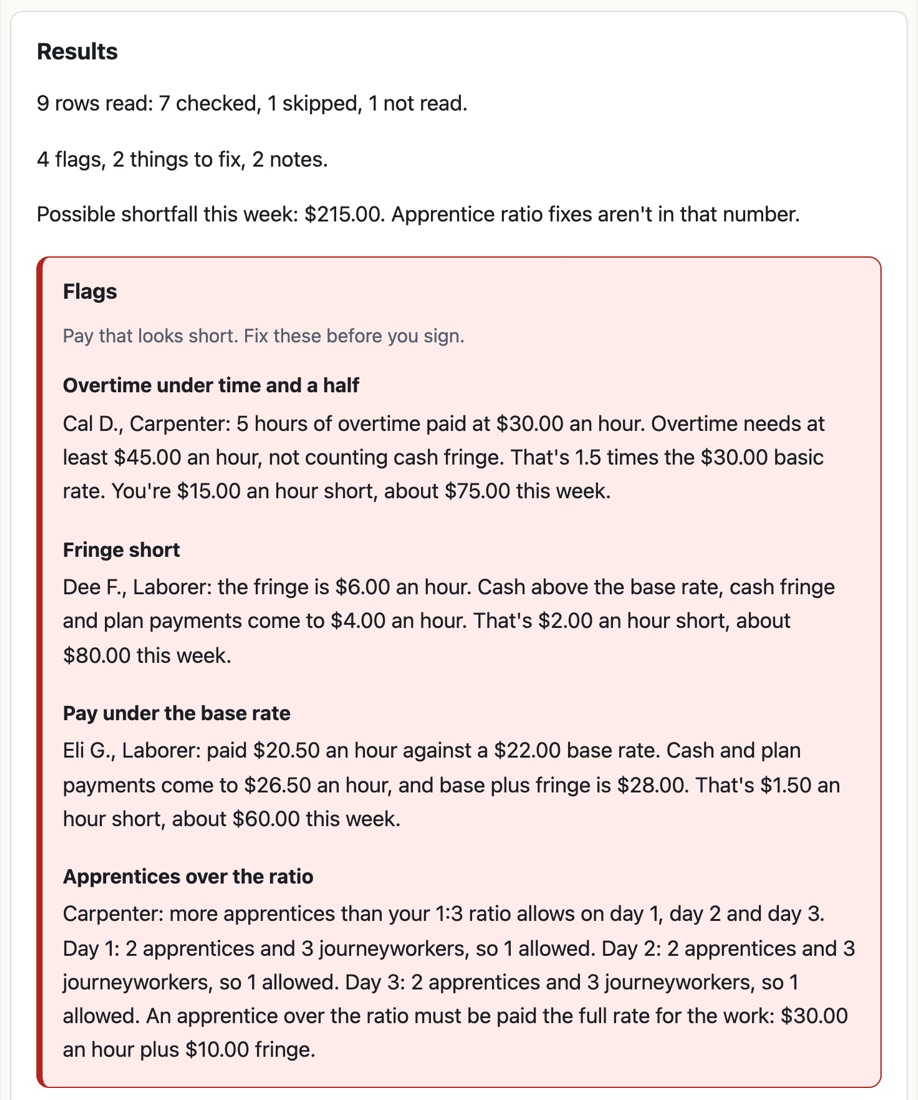
Count Twice checks math against the rates you type. It doesn't know New Jersey's daily overtime or overtime on benefits, it doesn't file with the Wage Hub, and it isn't a lawyer.
Next
If the job has federal money too, the federal rules can apply on top. What is certified payroll? covers the federal weekly routine. How prevailing wage is set.
Sources, each read 9 November 2026 (UTC):
- NJ Department of Labor: Prevailing Wage Act and public works page; public works prevailing wage FAQ; the Prevailing Wage Act and N.J.A.C. 12:60 and 12:62 as the Department publishes them; current prevailing wage rates; Wage Hub updates; Public Works Contractor Registration page and FAQ; press release of 7 June 2024 on the threshold
- Mercer County rates, file dated 19 October 2026, page 9, Carpenter
- 29 CFR 3.4, 5.5 and 5.32, eCFR